> For the complete documentation index, see [llms.txt](https://docs.clar.io/llms.txt). Markdown versions of documentation pages are available by appending `.md` to page URLs; this page is available as [Markdown](https://docs.clar.io/getting-data-out-of-clario/in-store-conversions/meta.md).
# Meta
## Step 1: Identify or create the offline event set
Clario needs an offline event set to send your offline conversion data to. Depending on your needs, you may have one or more event sets.
### Identify
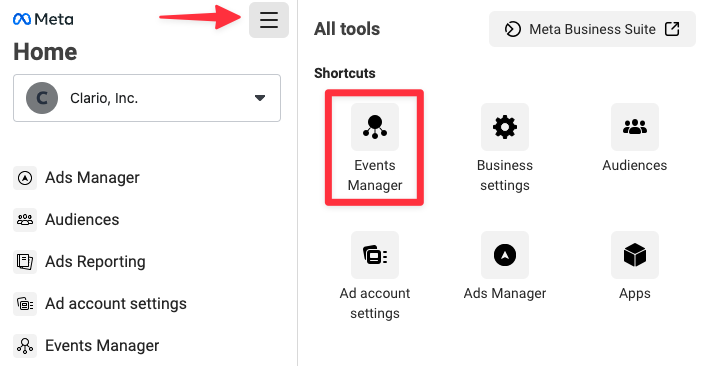
Sign in to [Meta Business Manager](https://business.facebook.com). Navigate to *Events Manager.*
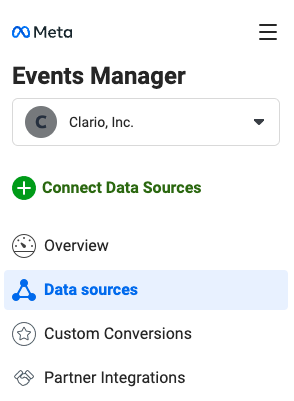
Within *Events Manager* navigate to *Data sources.*
{% hint style="warning" %}
**A note on data source types**
Meta deprecated the Offline Conversions API in v17 meaning offline event sets are no longer supported by Clario after 2023-08-15. You can identify an offline event set by looking at the label above the dataset ID:
\
\
The label *Offline event set id* indicates that this is data source is not supported.
{% endhint %}
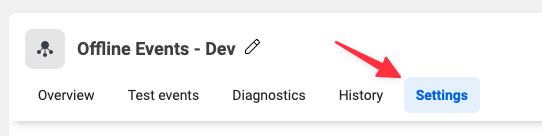
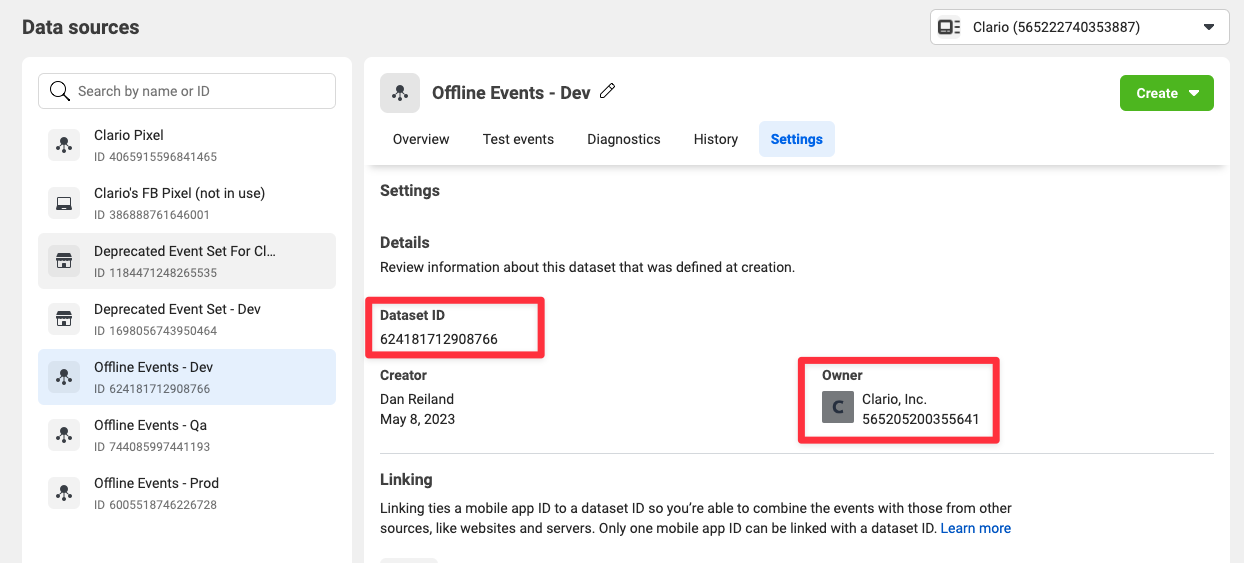
Meta will display a list of Data sources configured for your account. Select the data source you want Clario to utilize and click *Settings*.
Note the offline *event set ID* and *owner ID*. You will need these for step 2.
### Create
Meta provides a number of default offline data sources, however, they may not be where you want offline events persisted.
Datasets can be associated with one or more ad accounts. If you support multiple brands, a dataset per account may be appropriate. Meta provides [comprehensive documentation](https://www.facebook.com/business/help/5818684664831465?id=490360542427371) for creating datasets.
With your new dataset created, follow the instructions under [Identify](#identify) to gather the *event set ID* and *owner ID*.
## Step 2: Grant permissions
Sign in to [Meta Business Manager](https://business.facebook.com). Navigate to *Events Manager* -> *Data Sources.*
Meta will display a list of data sources configured for your account. Select the data source you want to modify and click *Settings*. Click *Share with a business.*
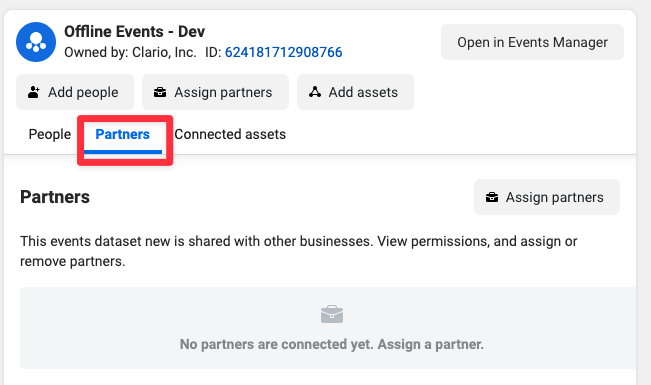
Select *Partners* to access the list of partners granted access to the data set.
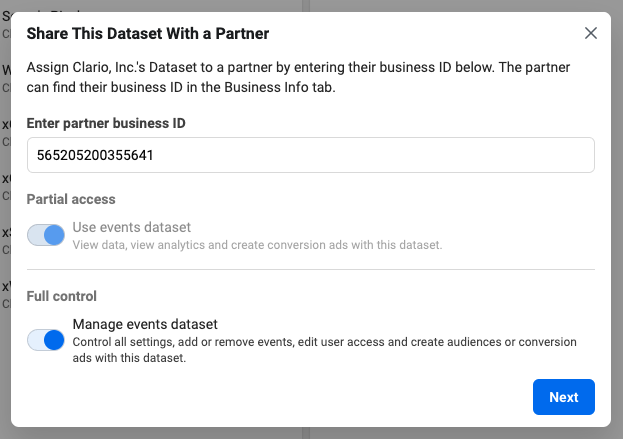
Click the *Assign partners* button. Enter Clario's partner business ID `565205200355641` and toggle the *Manage events dataset* access control.
Click *Next.* Read the terms and click *I accept.*
## Step 3: Share the details with Clario
Once you have identified the event set ID and owner ID, provide these details along with any associated brands (if applicable) to your Clario Customer Success representative.